

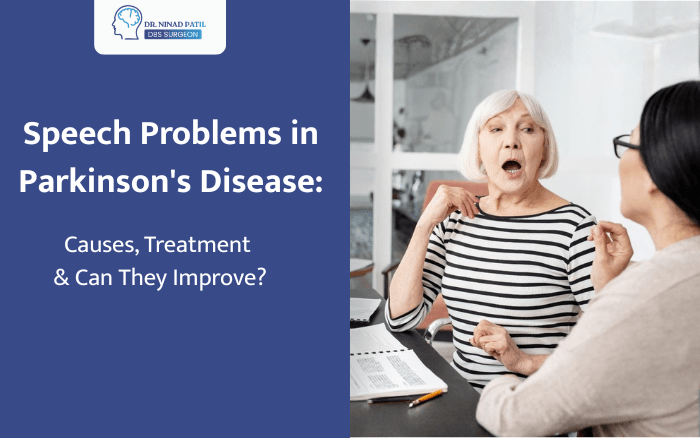
Living with Parkinson’s disease is challenging — but when it starts taking away your voice, it can feel truly isolating. Many people with Parkinson’s disease find that their speech changes quietly and gradually. The voice gets softer. Words start to slur. Conversations become exhausting. If this sounds familiar, you are not alone — and more importantly, there is real hope.
In this article, we’ll walk you through why speech problems in Parkinson’s disease happen, what treatments actually work, and whether improvement is genuinely possible.
Why Does Parkinson’s Disease Affect Speech?
Parkinson’s disease damages the part of the brain that controls smooth, coordinated movement. This includes the tiny muscles used for speaking — the lips, tongue, voice box, and breathing muscles.
As dopamine levels fall, these muscles become slower and weaker. The result is a condition called dysarthria — a speech disorder caused by poor muscle control.
Common Speech Changes to Watch For:
- Voice becoming very soft or whispery
- Speaking in a flat, emotionless tone
- Words coming out too fast and jumbled together
- Trailing off before finishing a sentence
- Difficulty starting to speak at all
- Slurred or unclear sounds
Studies show that up to 89% of people with Parkinson’s will develop some form of speech difficulty during their illness. Yet it remains one of the least talked-about symptoms.
Can Speech Problems in Parkinson’s Disease Actually Improve?
The short answer is yes — they can.
Speech is one of the few areas in Parkinson’s where the right therapy produces real, measurable results. Research on LSVT LOUD therapy — the most studied speech treatment for Parkinson’s — found that 88% of patients showed significant improvement in voice loudness after just four weeks of treatment.
The brain has a remarkable ability to adapt, even in a progressive condition like Parkinson’s disease. This is why starting speech therapy early gives the best results.
Treatment Options for Speech Problems in Parkinson’s Disease
1. LSVT LOUD Therapy
LSVT LOUD (Lee Silverman Voice Treatment) is the gold standard for treating Parkinson’s speech problems. It works on one simple but powerful idea — training the patient to speak LOUD.
Most people with Parkinson’s disease underestimate how quiet their voice has become. LSVT LOUD helps reset that internal volume dial. The programme runs over four weeks with four sessions per week, and improvements often last two years or more.
2. Speech-Language Therapy
A speech-language therapist can work with the patient on breathing support, clearer pronunciation, and controlling the rate of speech. Sessions are tailored to the specific problems each person is experiencing.
3. Daily Speech Exercises
Simple exercises done consistently at home can slow deterioration significantly:
- Hold a vowel sound (“Aaah”) for as long as possible
- Read aloud daily with expression
- Practice pitch variation — go from low to high
- Do lip and tongue stretches before conversations
4. Communication Aids
For those with more severe Parkinson’s speech difficulties, voice amplifiers and speech-generating apps can restore the ability to communicate clearly and independently.
5. Deep Brain Stimulation (DBS) and Speech
Deep Brain Stimulation (DBS) is a surgical treatment where small electrodes are placed in specific parts of the brain to reduce abnormal signals. It is mainly used to treat tremors, stiffness, and slowness of movement in Parkinson’s disease.
For some patients, better motor control after DBS surgery also leads to improved speech — particularly for those who struggled with motor fluctuations that made speaking inconsistent throughout the day.
However, DBS is not suitable for everyone, and its effect on speech depends heavily on patient selection and surgical skill. This is why consulting a specialist who carefully evaluates speech as part of the overall treatment picture is so important.
Practical Tips for Caregivers
If you care for someone with Parkinson’s disease speech problems, these small changes make a big difference:
- Always face them while talking — remove background noise
- Never rush them or complete their sentences
- Ask simple yes/no questions when speaking is hard
- Remind them gently to slow down and speak up
- Keep a notepad nearby for important conversations
Patience and encouragement go a long way. Confidence in communication is closely tied to how supported a person feels.
FAQ
Q: Is it normal to have speech problems with Parkinson’s disease?
Yes. Speech and voice changes affect the majority of Parkinson’s patients and are considered a very common part of the condition.
Q: Does Parkinson’s medication help with speech?
It can help slightly in some patients, but medication alone is rarely enough to address Parkinson’s speech problems. Therapy is usually needed alongside it.
Q: At what stage does speech get affected?
Changes can start early but typically become more noticeable in the mid-to-later stages of Parkinson’s disease.
Q: Can DBS surgery make speech worse?
In some cases, if the surgical target is not selected carefully, DBS can affect speech. This is why choosing an experienced DBS surgeon is critical.
Consult Dr. Ninad Patil — DBS Surgeon for Parkinson’s Disease Treatment in Pune
If you or a loved one is dealing with Parkinson’s disease including speech problems, tremors, or loss of motor control — speaking to the right doctor early can change the outcome significantly.
Dr. Ninad Patil is a trusted DBS surgeon forParkinson’s disease treatment in Pune. He works with patients to evaluate all available treatment options including whether Deep Brain Stimulation is the right step — while keeping the patient’s full quality of life in focus, including their ability to speak and communicate.
Book a Consultation Today
Don’t wait for Parkinson’s speech problems to get worse. Reach out to Dr. Ninad Patil’s clinic in Pune and take the first step toward better treatment and a better quality of life.