

What Is Deep Brain Stimulation Surgery?
Imagine waking up one day and not being able to hold a cup of tea steady. Your hands shake, your movements feel stiff, and simple tasks feel exhausting. For millions of people living with Parkinson’s disease, essential tremors, or dystonia, this is everyday life.
Deep brain stimulation surgery offers real hope. It’s a proven procedure where a small device — much like a pacemaker — is implanted to send gentle electrical signals to specific areas of the brain. These signals help correct the faulty communication causing tremors, stiffness, and loss of control. And now, thanks to robotic technology, DBS surgery has become safer and more accurate than ever before.
Traditional DBS vs. Robotic DBS — What’s Actually Different?
Traditional deep brain stimulation surgery relied heavily on the surgeon’s hand and manual tools to place a tiny electrode deep inside the brain. While skilled surgeons achieved good results, there were real limitations — even a fraction of a millimetre off-target could affect outcomes.
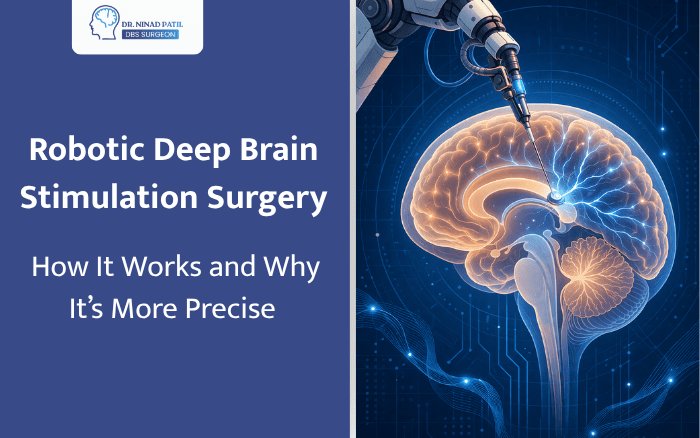
Robotic DBS surgery changes this entirely. A robotic arm, guided by real-time 3D brain imaging, helps the surgeon place the electrode exactly where it needs to go. The difference comes down to three things:
- Accuracy — Robotic systems operate with sub-millimetre precision
- Safety — Less manual handling means reduced risk during surgery
- Speed — Shorter time in the operating room means less stress on the patient
It’s the same surgical goal, done with far greater control.
How Robotic Deep Brain Stimulation Surgery Works — Step by Step
Step 1: Brain Mapping Before Surgery
Before anything begins, the surgical team creates a detailed 3D map of the patient’s brain using MRI and CT scans. This helps identify the exact target — often a region the size of a small pea — responsible for the patient’s symptoms.
Step 2: Robotic Targeting
On the day of surgery, the robotic system uses the pre-planned map to guide the electrode along the safest, most direct path. There’s no guesswork. The robot holds a position with rock-solid steadiness that even the most experienced human hand cannot match consistently.
Step 3: Electrode Placement and Device Programming
Once the electrode is placed, a small pulse generator (the “brain pacemaker”) is implanted under the collarbone. Over the following weeks, the device is programmed — fully from outside the body — to match the patient’s specific needs.
Step 4: Recovery
Most patients go home within 2–3 days. Full programming and symptom improvement typically develops over 4–6 weeks as the brain adjusts to stimulation.
7 Reasons Why Robotic DBS Surgery Delivers Better Results
- Real-time imaging keeps the surgeon fully informed throughout the procedure
- Robotic guidance removes the variability that comes with manual placement
- Shorter surgery time reduces anaesthesia exposure and overall risk
- Better electrode targeting leads to stronger symptom relief
- Lower chance of complications such as bleeding or infection
- Adjustable and reversible — settings can be changed without further surgery
- Proven results — studies show up to 70–80% reduction in tremor severity in Parkinson’s patients
What Results Can You Realistically Expect?
Robotic deep brain stimulation surgery doesn’t cure Parkinson’s or eliminate the condition. What it does — and does very well — is reduce the severity of symptoms significantly. Most patients report:
- Fewer and less severe tremors
- Better control of movement
- Reduced dependence on medication
- Improved ability to carry out daily tasks independently
Research shows over 90% of well-selected patients are satisfied with their DBS surgery outcomes. The key phrase here is “well-selected” — which is why choosing the right surgeon for a thorough evaluation matters so much.
It’s also worth being honest: DBS surgery is not suitable for everyone. Patients with significant memory issues, severe depression, or certain structural brain changes may not be good candidates. A proper consultation helps make this clear from the start.
How to Choose the Right DBS Surgeon
When it comes to robotic DBS surgery, experience is everything. Here are five questions worth asking any surgeon you consult:
- How many DBS surgeries have you performed?
- Do you use robotic assistance for electrode placement?
- What imaging technology do you use for pre-surgical planning?
- How do you handle post-surgical programming and follow-up?
- What is your complication rate?
A surgeon with years of focused experience in deep brain stimulation will answer all of these with confidence and clarity.
Take the Next Step Toward a Steadier Life
Living with uncontrolled tremors or Parkinson’s symptoms doesn’t have to be permanent. Robotic deep brain stimulation surgery is giving patients across India a genuine path back to independence.
If you or someone you love is struggling with Parkinson’s disease, essential tremors, or dystonia, speaking with a qualified DBS surgeon in Pune is the most important first step you can take.
Dr. Ninad Patil is a leading neurosurgeon in Pune with 9+ years of focused experience in deep brain stimulation surgery. He has helped hundreds of patients regain control, reduce their tremors, and get back to living their lives. His approach is straightforward — a thorough evaluation, honest guidance, and the best surgical care available in the region.
Book your consultation with Dr. Ninad Patil today and find out whether robotic DBS surgery is the right choice for you.
FAQ
Q1: Is robotic DBS surgery safe?
Yes. The robotic system reduces human error, uses real-time imaging, and helps the surgeon work with consistent accuracy throughout the procedure.
Q2: How long is the recovery?
Most patients are home within 2–3 days, with noticeable improvement developing over 4–6 weeks as the device is programmed.
Q3: What conditions does DBS treat?
DBS surgery is approved for Parkinson’s disease, essential tremor, dystonia, and OCD. Research into other conditions is ongoing.